
29. nov., 2022
A question frequently comes up: where do myths come from, what are their origins?
The symbolic analysis of the myth is also developed in the form of videoconferences in the training proposed by Réenchanter le monde.https://reenchanterlemonde.com/mythologie
The astrological keys to the myth of Icarus
The author shows us how the story of Daedalus and his son Icarus is emblematic of our techno-scientific society, which is constantly creating new labyrinths and where complexity reigns supreme. He also discusses the ways out of this complexity: the liberal arts taught in the Middle Ages and the shamanic experience that leads to death and rebirth. In this introduction to the myth of Icarus, the author offers astrological keys for determining whether a person is inhabited by this myth, as well as a practical way of reviewing allitssignifiers.

INTRODUCTION TO THE ICARE MYTH, A PASSION FOR THE SUN: parte 1
Myths 'organise' our biological, psychological, social and spiritual reality at least as much as our genetic make-up, education and cultural context. Daedalus, Icarus' father, was a brilliant engineer who always had a practical answer to every question. He had an unshakeable faith in the omnipotence of technology. Icarus benefits from this knowledge, but lacks his father's maturity. The use of a new invention, artificial wings, would prove fatal for him. This retelling of the myth of Icarus by Luc Bigé invites the reader to question the philosophical assumptions of technical thinking and its consequences for future generations. Above all, it accompanies Icarus in his extraordinary attempt to move towards a better world, far removed from the complexity of all our relational, professional and even roadside labyrinths. A world free of the daily lies, a world of hope where the truth of the heart takes precedence over coldness and the need for security.

INTRODUCTION TO THE ICARE MYTH, A PASSION FOR THE SUN: parte 2
Myths are always the degradation of an archetype. Apart from the labours of Hercules, mythological heroes always go from bad to worse, the image degrades, is, goes from bad to worse. That’s is why we need to read the myths by returning from the destruction to the origin, in order to know how to take the road back to solve the problems that the myths expose. The problem with the myth of Icarus is that it considers the Minotaur to be a monster. In other words, he considers that there are values in him that are monstrous and that he doesn't consider them at their true value. He prefers to hide them in the labyrinth. The labyrinth in the myth represents a way of intellectualising and representing himself to the world in order to hide his shame, his difference.

Introduction to the symbolism of the Faust myth
In the Faust myth there is both a need for ontological transformation and a resistance to this transformation. Faust's dilemma represents his need to seek out disciplines that would enable him to metamorphose, to transform himself internally. But he will use them more for others than for himself. For his greatest difficulty will be to lose control. The only way to lose control and enter into a true metamorphosis is to accept the death of his representations. The symbolic death of his social representations, his attachments, his wealth, his loves and his habits. Faust's ambivalence lies in his desire to learn about all systems of understanding. To this end, he is interested in theology, medicine, astrology, metaphysics, magic and the occult. In all cases, the Faustian will seek to understand the phenomena and mechanisms of inner patterns in order to understand how the essence of human nature works. However, it is his need and desire to use his intellect to understand the phenomena of his human nature that is the obstacle to his own transformation. The function of Faust's intellect is not only to provide knowledge, but it is also a means to protect himself from the reality of his experiences. Thus, we can conclude that Faust will be able to achieve his metamorphosis if he experiences it directly. That is to say, he allows himself to pass through places and situations where he can become (without thinking). It is from this dimension that he will be able to meet Hades (who is formless and thoughtless) and descend into his depths to meet the true metamorphosis. Faust's power then becomes a capacity for rebirth that no longer comes from knowledge but from the lived immediacy of each moment of hisexperiences.
The astrological keys to the Faust myth:part one
Reading the myth in relation to the Zodiac
As we did with the myth of Narcissus, Luc Bigé proposes an additional approach to understanding the myth of Faust, to see the areas of opening and closing of the myth, by positioning the myth in relation to the Zodiac.

The astrological keys to the Faust myth: Part 2
The author proposes here a few themes of historical figures who have a Faust myth. This gives us examples of how to detect a Faust myth in an astrological chart. Let's not forget that this is a gradient and that there are great and small Faust myths.

Transhumanism and Posthumanism
Article by Luc Bigé
The mythology of the Black Moon in astrology.
Within the theatre of existence the astrological signs describe the atmosphere of the play: Is it a drama? A comedy? An initiation story? These are qualities of diffuse energies spread over 30° of zodiacal space, a sort of materia prima from which the actors, in fact the planets, will draw inspiration. These are active and affirmed psychological functions. These actors can adore each other (conjunctions), compete with each other (squares), work together (sextiles), complement each other or hate each other (oppositions), walk hand in hand (trigones). They need settings to express themselves and to implement their potential: these are the astrological houses. Twelve settings, twelve archetypal fields of experience, dot our daily lives and, ultimately, test our willingness to make visible the invisible within us. In this context, the Black Moon will be the author of the play. The inaccessible star which, while remaining hidden, seeks, through various narrative forms - life stories - to convey a deep, essential and vital meaning. We call this meaning the founding myth of the person. Generally, this primary Idea that inhabits and organises the subject's existence is not easily revealed because memories of fears and a deep feeling of non-existence prevent it from being brought to consciousness. Sometimes, too, the author of the theatre of life prefers to remain anonymous if he feels that the time has not yet come, that the play - the personality - must still mature before revealing itself, in all its force of intransigence. In terms of interpretation, the Black Moon adds a vertical dimension to the classical reading of the birth chart. It explores the depths of the psyche until it reaches its extremely ambiguous roots, with ablindinglight.
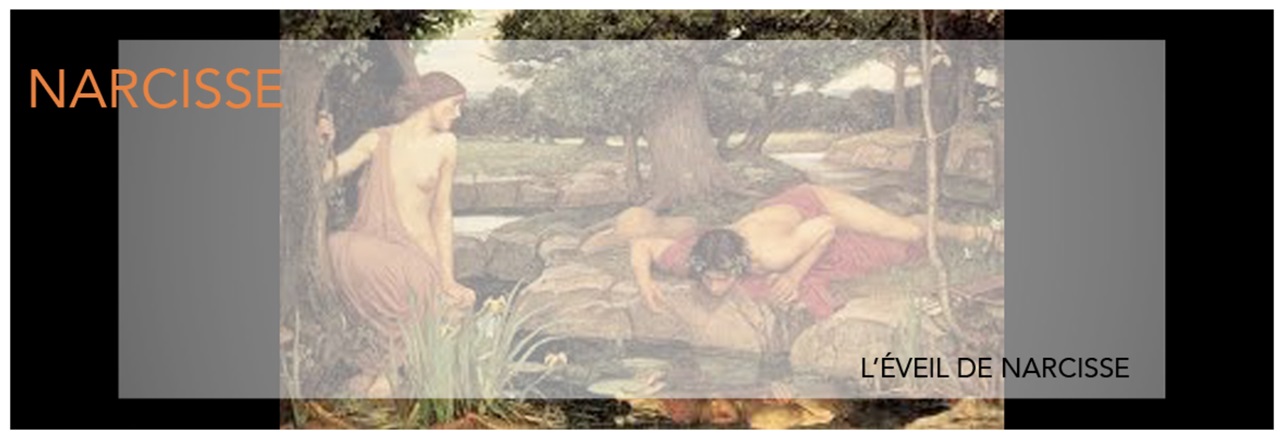
"The essentials” of the Narcissus myth
The Greek word for 'Narcissus' means 'narcosis'. The handsome teenager whose adventure Ovid recounts in his Metamorphoses therefore has a numb conscience. He does not "know himself", as the soothsayer Tiresias, whom his mother consulted as soon as her child was born, reminds us. By radically departing from the classical psychoanalytic approach to the myth of Narcissus, the author renews our understanding of this story about human nature. Is man not, in fact, an immense Narcissus, looking at himself without caring for the suffering inflicted on the other kingdoms of nature? A symbolic analysis of the events of Narcissus' life shows that 'narcissism' is a pathology only for a very short time in the myth. In fact, the story describes a process of inner evolution, with very precisely described stages, leading to awakening, to coming out of narcosis. Step by step, Narcissus learns to know himself, which is why, according to the prophecy of the soothsayer, he will die to his former identity in order to be reborn in the splendour of the flower that bears his name. The lives and works of some of the most famous Narcissi help to illustrate the luminous face of this adolescent in search of himself in his intimate images. Rembrandt, Dali, Proust and a few others belong to the great family of those who have dared to explore their dream world, resulting in the creation of a unique work that contains a summary of the world.

The astrological keys to the Narcissus myth
I would like to mention for a moment the narcissistic side generally interpreted in psychoanalysis in its pathological sense; however, there is also a bright side to narcissism! Even though the pathology of narcissism is very real, it is primarily a process to be accepted rather than repressed, as we are all, to varying degrees, narcissists! There are times when life demands, willingly or unwillingly, that we turn our projections back onto ourselves, that we look with vigilance and intention at the mode of expression that inhabits us. Our vision is directed towards ourselves not out of excessive navel-gazing, but in order to experience a pressure and concentration of experience that will have the effect of cleansing the shadow parts ready to be transformed. From this angle of perception, a form of involution will have extended its hand to a new evolution, giving us the opportunity to become ourselves by pursuing our life in search of our true nature, often called the being, the soul, or the Self. This Self that has always been there, but that we had lost sight of, precisely because of our past identification with our narcissistic identity. Depending on how we consider it, narcissism remains a means or an obstacle to our development. One aspect that seems essential to me, if we repress the narcissistic part and/or if we identify with it, it will not have the opportunity to bring to light, in our consciousness, the mechanisms of its functioning. Thus, the necessary transformation on the path from myth to the bright side of self-knowledge will not be able to take place. The myth invites us to cross the mirror that represents the sensitive images of our interiority. It allows us to detach ourselves from the echo of the world, from the ideology that we borrow from others, from projections and memories, from the fear of lack and suffering, to accept to detach ourselves from the object of our love in order to let love burst forth.
Cleaning the stables of Augias
In this work, Hercules reconciles light and shadow, he wants to remind everyone that exploring the darkness is as important as perceiving the light, which remains the essence of this work.
The myth of the hero, The Lion of Nemea
The Call. Who has not felt the call in his heart? Like an immense whisper that pushes the being to become totally different from what it seems now; like a germination when the still fragile shoot strives to break through the resistance of the seed to become a seed. To break through the resistance of the old world to affirm a new life filled with joy and love is the meaning of the call. The myths have preserved for us the memory of this path where "I" finally becomes "another" after many tribulations... where "I" becomes what it has always been. In his early years, Hercules almost became a delinquent, but fortunately a privileged education turned him away from crime. Then his ambition led him to make a name for himself in the city. To prevent him from drowning in fame and social success, Hera drove him mad: the man suddenly burned in a huge inferno everything that attached him to his former way of life. Only then did the twelve labours begin, so many stages of inner transformation that would lead the hero from ordinary life to extraordinary life. As soon as his first Work, the capture of the Lion of Nemea, was completed, he could no longer return to the city, but could only deposit the fruits of his efforts at the foot of the ramparts. Still in this world but already out of it: such is the fate that accompanies the one who has chosen to listen to the inner call and to change his human nature a little deeply. Myths are ageless. The story of the greatest of the ancient Greek heroes still accompanies us today in this process of inner transformation from the personal to the impersonal, from ordinary life to profound life, from death to the awareness of our immortality. As a solar hero, Hercules travels the zodiac leaving each astrological sign in correspondence with one of his twelve labours. These correlations have not been definitively preserved by tradition. This is why we discuss the different possible attributions in order to facilitate the location of each one in his own heroicadventure.

Summary, the capture of the Lion of Nemea.